
Tempo de leitura: 4 minutos
Why Are Cambodia’s Special Economic Zones Driving Manufacturing and Investment?
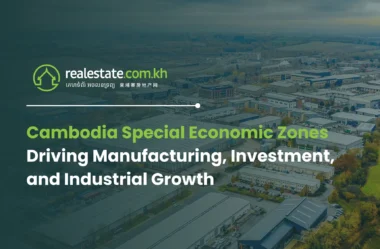
Cambodia’s Special Economic Zones (SEZs) have become a cornerstone of the country’s industrial development, helping transform Cambodia into a competitive manufacturing and export destination in Southeast Asia.
Over the past two decades, SEZs have attracted billions of dollars in foreign direct investment (FDI), generated hundreds of thousands of jobs, and strengthened Cambodia’s role in regional and global supply chains.
Today, these industrial hubs are home to some of the world’s leading manufacturers across the automotive, electronics, garment, footwear, and consumer goods sectors.
What Are Special Economic Zones?
Special Economic Zones are designated industrial and commercial areas established to encourage investment, promote exports, and support economic growth. Unlike conventional industrial areas, SEZs offer businesses a combination of investment incentives, streamlined administrative procedures, and purpose-built infrastructure designed to simplify operations.
Modern SEZs provide investors with ready-built infrastructure including internal road networks, reliable utilities, telecommunications, warehouses, and factory facilities. Many also operate on-site customs offices and bonded warehouses, allowing manufacturers to import raw materials and export finished products more efficiently.

This integrated approach significantly reduces development timelines and operational complexity, enabling manufacturers to begin production much faster than if they were developing standalone industrial facilities.
Additional Read: Cambodia’s Construction Sector: Key Trends & Investment Opportunities
For investors, SEZs reduce both upfront investment risk and operational friction, making Cambodia a more accessible manufacturing destination. For manufacturers and exporters, this means faster business setup, easier customs procedures, and access to facilities that are ready for production from day one.
Cambodia’s Growing SEZ Network
According to the Council for the Development of Cambodia (CDC), the country has 56 SEZs, with 33 currently operational, managed by 28 developers and operators.
Together, these zones have attracted more than 1,062 investment projects, representing approximately US$13.7 billion in investment capital while creating employment for around 245,000 people.
The country’s SEZs are strategically located near major transport corridors, international border crossings, airports, and seaports, enabling manufacturers to efficiently connect with regional and global markets.
Download the Full Cambodia Industrial & Logistics Snapshot 2026 Here to Learn More!
For example, Bavet serves as a gateway to Vietnam, Poipet links Cambodia with Thailand’s manufacturing corridor, while Sihanoukville offers direct access to the country’s largest deep-sea port. Industrial zones around Phnom Penh also benefit from the capital’s skilled workforce, expanding road network, and the new Techo International Airport.

Global Manufacturers Continue to Invest
The growing diversity of Cambodia’s industrial sector is reflected in the international companies that have established operations within the country’s SEZs.
Global manufacturers with operations in Cambodia include Adidas, Nike, Puma, Coca-Cola, Toyota, Ford, BYD, Denso, MinebeaMitsumi, Nidec, Yazaki, NHK Spring, Betagro, Yeo’s, and suppliers supporting brands such as Uniqlo, and many more as well.
Their presence demonstrates that Cambodia is no longer viewed solely as a low-cost manufacturing destination. Increasingly, it is being recognised as a strategic production base capable of supporting regional and global supply chains across multiple industries.
The continued arrival of Japanese, Chinese, South Korean, European, and ASEAN manufacturers also reflects growing confidence in Cambodia’s long-term industrial potential.

Why Investors Choose Cambodia’s SEZs
The continued growth of Cambodia’s SEZ sector is driven by several competitive advantages.
Investment Incentives
Businesses may benefit from tax holidays, import duty exemptions, and other incentives available under Cambodia’s investment framework, helping reduce setup and operating costs.
Ready-Built Infrastructure
SEZs provide essential infrastructure, including roads, electricity, water supply, telecommunications, factories, and warehouses, allowing businesses to begin operations more quickly than developing standalone industrial sites.
Efficient Customs and Administration
Many SEZs feature on-site customs offices and bonded warehouses, enabling faster import and export processing. Investors also benefit from more streamlined licensing and administrative procedures.
Regional Market Access
Cambodia’s participation in major trade agreements, including RCEP, the Cambodia-China Free Trade Agreement, and ASEAN trade frameworks, gives manufacturers preferential access to key international markets.

Strong Outlook for Industrial Real Estate
Cambodia’s continued investment in infrastructure, including expressways, port upgrades, and the new Techo International Airport, is expected to further strengthen the competitiveness of its SEZ network and improve national logistics connectivity.
As manufacturing activity expands, demand for industrial land, ready-built factories, warehouses, and logistics facilities is expected to continue growing.
More than simply industrial estates, Cambodia’s SEZs have evolved into integrated business ecosystems that support manufacturing, trade, and export-oriented industries. With over US$13.7 billion invested across more than 1,000 projects, they remain one of the country’s most important drivers of industrial growth and a key destination for investors looking to establish operations in Southeast Asia!
Ready to explore Cambodia’s industrial opportunities?
From Special Economic Zones and industrial parks to factories, warehouses, and logistics facilities, Realestate.com.kh is your trusted source for Cambodia’s industrial real estate market.
Download the Cambodia Industrial & Logistics Snapshot 2026 to access comprehensive market data, investment insights, and location analysis designed for investors, developers, manufacturers, and occupiers.
Fonte: Real Estate | Foto: Reprodução




Os comentários foram encerrados, mas trackbacks e pingbacks estão abertos.