

Tempo de leitura: 2 minutos
Natalia Fernández | Special Economic Zones (SEZs) are undergoing a profound transformation. In a context marked by the restructuring of supply chains, the energy transition, and growing global competition for investment, their role is evolving from simple industrial spaces to strategic platforms for economic development.
In this article developed by IDOM in collaboration with NurZen, we analyze what sets the most competitive economic zones apart on an international level and what implications this has for the MENA region.
A new context for global investment
Global investment trends are changing rapidly. Factors such as nearshoring, digitalization, and sustainability requirements are redefining investors’ location decisions.
In this context, SEZs no longer compete solely on the basis of tax incentives or land availability, but rather on their ability to offer integrated, efficient environments that align with investors’ expectations.
Five keys to success for the most competitive SEZs
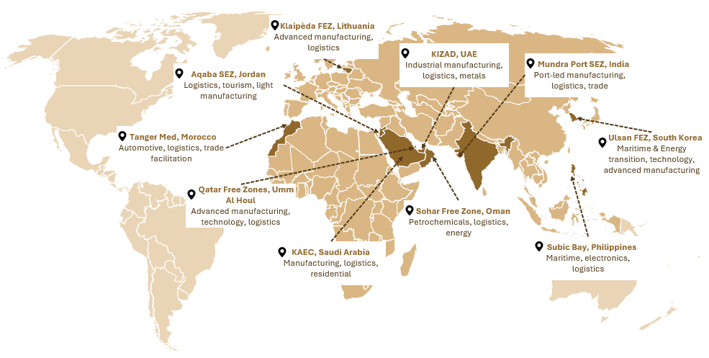
An analysis of a selection of leading regions worldwide reveals five distinguishing factors that explain their success:
- Specialization: sector focus vs diversification
The most successful regions do not try to attract every sector; instead, they build their strategy around clear areas of specialization.
This approach allows them to generate economies of scale, consolidate value chains, and attract more qualified investors. Examples such as Tanger Med and Ulsan demonstrate how the development of sector-specific clusters enhances the global competitiveness of these regions.
- Governance: A strategic asset
The quality of governance is a key factor in the performance of SEZs. Hybrid models, which combine public leadership with private operational management, are proving to be more effective than exclusively public or private approaches.
Furthermore, clear regulatory frameworks and strong institutional coordination provide the predictability that international investors demand.
- Investor services: from infrastructure to expertise
Competition among SEZs is shifting toward the quality of the investor experience. Tools such as one-stop-shop digital platforms, logistics management systems, and personalized support services have become essential for attracting and retaining investment.
- Sustainability: From obligation to competitive advantage
Sustainability has evolved from a regulatory requirement to a key element of the value proposition. The most advanced regions are integrating renewable energy, circular economy solutions, and decarbonization strategies as drivers of competitiveness and a means of attracting high-quality investment.
- Integrated ecosystems: beyond the industrial park
Leading SEZs no longer function as isolated spaces, but rather as ecosystems that integrate industry, logistics, innovation, talent, and urban services. This approach fosters innovation, improves business retention, and strengthens the ability to attract specialized talent.
Implications for the MENA region
The MENA region has significant structural advantages, such as its strategic geographic location, access to global trade corridors, and robust infrastructure investment programs.
However, it also faces significant challenges:
- Need for greater sectoral specialization
- Increased international competition
- Growing sustainability requirements (ESG)
- Demand for advanced digital services for investors
Capitalizing on the current window of opportunity will depend on the region’s ability to adapt its SEZs to these new requirements.
Fonte: Idom | Foto: Reprodução





Os comentários foram encerrados, mas trackbacks e pingbacks estão abertos.