

Tempo de leitura: 2 minutos
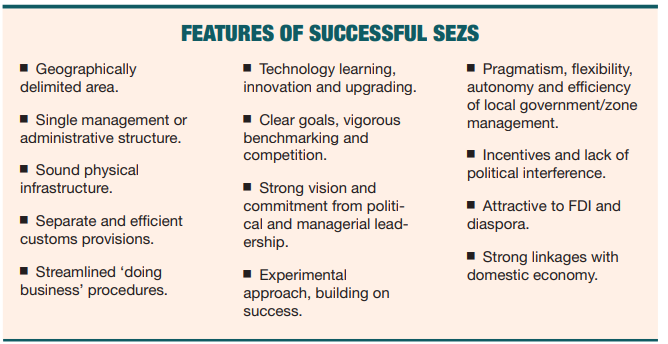
Special Economic Zones (SEZs) have been established in many countries as a mechanism for attracting foreign direct investment, accelerating industrialization and creating jobs. Not all SEZs have been successful, and a review of experience indicates factors that contribute to success.
China has successfully leveraged SEZs for economic transformation. Initially, SEZs were used to experiment with market-oriented economic reforms and build experience before reforms were implemented more widely. Over time, a wide range of SEZs were established to take advantage of local conditions. These include large national zones, whose objective is to foster broad-based and comprehensive economic development, high-tech industrial development zones, free trade zones, export processing zones, as well as other models at both national and regional levels. Although there is no single model, all successful Chinese SEZs are supported by conducive government policies and long-term commitments.
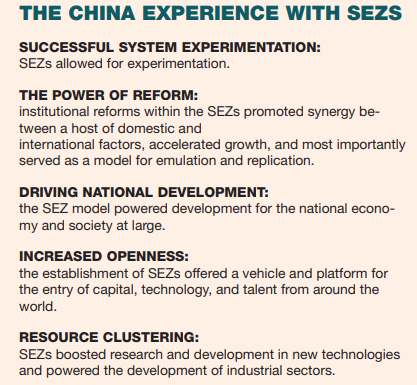
SEZs have made significant contributions to China’s economic progress. In recent years, it is estimated that they have accounted for 22% of national GDP, 46% of foreign direct investment, 60% of exports, and have generated more than 30 million jobs. In some regions, industrial parks account for as much as 80% to 90% of GDP growth. National-level industrial parks, particularly agro-technology parks and agricultural demonstration zones, make a demonstrable contribution to farmers’ incomes. On average, agricultural incomes within these parks are more than 30% higher than incomes in surrounding villages.
SEZs and industrial parks have also spurred technology and innovation. Across China, the contribution of technological development to agriculture stands at 55.2%, while industrial park-based contribution rates reach roughly 70%, close to the average level for developed nations. China’s overall technology commercialization rate is approximately 10%, but industrial parks boast commercialization rates exceeding 60%.
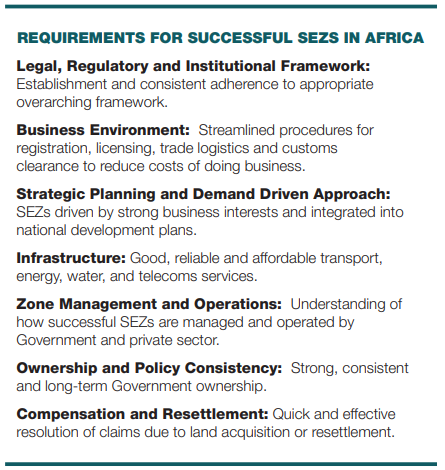
Several African countries have launched SEZs since the 1970s; however, to date, they have not matched China’s successful experience, frequently because the requisite combination of enabling factors has been lacking.
- Identify the needs of both the host
country and the investor and design
SEZs that can be replicated. - Understand the local conditions and
comparative advantages. - Institute and implement conducive
policies for industry, finance, talent
and taxes. - Formulate SEZs that facilitate
local entry and integrate primary,
secondary, and tertiary industries. - Establish dialogue and cooperation
mechanisms between SEZs and
Government, build and extend
industrial value chains, and integrate
research and development. - Develop and implement management
and operational structures that
incorporate best practices and exploit
local and investor strengths. - Require SEZs to be internationally
and locally competitive and avoid
proliferation of non-viable zones. - Ensure compliance with strong
environmental standards and
encourage use of green technologies. - Focus on provision of social services
and benefits as well as industrial
development.
SEZs are not a panacea, and must
be properly planned, managed and
operated to be successful.





Os comentários foram encerrados, mas trackbacks e pingbacks estão abertos.