
Tempo de leitura: 5 minutos
For Xi Jinping, a summit in the high-tech hub of Shenzhen this week is an opportune moment to showcase a vision of China’s unrelenting rise.
Xi is hosting business moguls and world leaders for an annual regional economic summit, where he’ll sit down to sideline talks with US President Donald Trump and hold a three-way meeting with Trump and Russia’s Vladimir Putin, a first-ever trilateral for the nuclear-armed powers.
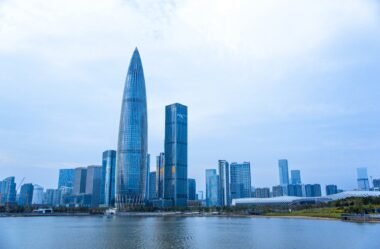
And for his backdrop, Xi has chosen a host city that’s synonymous with China’s rapid transformation into a high-tech powerhouse – and its resilience in the face of US tech and trade frictions.
A sprawling metropolis of 18 million, Shenzhen is home to a who’s-who of Chinese tech titans: hardware giant Huawei, dronemaker DJI and the Tesla-beating electric vehicle seller BYD – all companies that have thrived despite US import bans or blacklists.
Once known as the capital of luxury knockoffs and cheap electronics, today the city’s high-tech products have helped propel China’s export juggernaut to a record $1 trillion trade surplus already this year.
Visiting VIPs who step out onto Shenzhen’s streets this week will find traffic that moves to the whir of homegrown electric vehicles and novelty kiosks where robots serve up coffee. Self-driving taxis ferry passengers and drones deliver take-out in some areas. Surveillance cameras are ubiquitous.
The high-tech vision may make for a sharp contrast to the US, where news this week has been dominated by a series of systems outages and a revelation that up until a few months ago the country’s aviation administration was still using floppy disks.
For Beijing, the choice of setting is a clear signal to the world of its confidence in the country’s momentum at a moment of intense tech competition with the US.
Those optics only came into sharper focus in recent days, as a scandal engulfing American AI chipmaker Nvidia triggered fresh calls to limit China’s access to high-end American technology – a developing situation that could upend a period of relative stability between the two economies.
The US Commerce Department earlier this week fired the first shot, unveiling a new rule meant to close loopholes that had allowed Chinese companies to access advanced American chips overseas.
Beijing called the move an “abuse of export control measures” and “unjustifiable suppression.”
Tech rivalry
Even before the latest escalation, pushing back against a US that has increasingly looked to limit Chinese access to key technologies – and dissuade other countries from using China’s – was already baked into Xi’s narrative for Shenzhen.
The Chinese leader is taking his turn hosting the annual Asia-Pacific Economic Cooperation (APEC) summit, a group of nearly two dozen economies from both sides of the Pacific. Members include Southeast Asian nations, Mexico, Canada, Australia and Japan.
And Xi hopes that he may find a sympathetic audience among a group of nations that too have been buffeted by US tariffs and global fuel price shocks driven by Trump administration policies, including the war with Iran.
Speaking to business leaders in his opening address at the summit on Wednesday, Xi framed China as a defender of globalized trade, calling for countries to reject “unilateralism and protectionism” and keep supply chains open.
He also called for deeper AI cooperation – part of the leader’s ongoing bid to pitch China as the leader of a global AI order shaped around a view that the technology should be treated as a “public good.”
It’s a conscious contrast to a message from US officials, who will join the summit in China fresh from meeting with allies in Manila, where they likely touted their Pax Silica initiative. That plan aims to get countries to agree to keep China out of sensitive AI supply chains.
Xi’s message is an urgent one for Beijing to sell. China’s economy is heavily reliant on its massive, and increasingly high-tech, export engine – and it’s wary of countries around the world throwing up barriers to protect domestic industries from those goods.
“Beijing wants these participants to leave believing that engagement with China remains essential to their prosperity,” said Han Lin, who leads China operations for The Asia Group consultancy in Shanghai. For China, the summit “is an opportunity to demonstrate that it remains central to Asia’s economic future.”
Global heavyweights
But attention from Xi’s main show may be stolen by diplomacy on the summit sidelines, where the Chinese leader’s meetings with Trump and Putin will be another choreographed case in point for China’s growing global heft.
Beijing has historically seen meetings with an American president as a way to signal China’s international clout both to its domestic and international audiences.
Now, Xi will be hosting what is his third face-to-face meeting with Trump already this year. And even in a historic meeting with Trump and Putin, it’s Xi who appears to be joining the three-way talks in a position of power.
Trump is fresh off a bruising defeat in US midterm elections – and entering the backend of his final presidential term. Putin is on what is now a rare international visit after the war in Ukraine made him a global pariah – and sunk his economy.
Xi, meanwhile, is expected to cement a fourth term atop China’s authoritarian system at a Communist Party conclave next fall.
The trilateral meeting, which Beijing has called “groundbreaking” and said will be a chance to discuss “major issues concerning global peace,” may ultimately yield few tangible outcomes.
Xi and Trump, who could meet a further time this year, are expected to use their bilateral this week as a touchstone in ongoing trade negotiations, rather than a moment for hefty breakthroughs.
But for Xi, those optics – of high-powered diplomacy before a backdrop calibrated to showcase China’s technological rise – may be outcome enough.
Fonte: CNN | Foto: Pixabay


Os comentários foram encerrados, mas trackbacks e pingbacks estão abertos.