
Tempo de leitura: 5 minutos
What Is a Special Economic Zone (SEZ)?
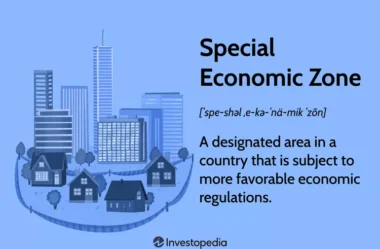
Special Economic Zones (SEZs) are strategically designated areas within a country that aim to enhance economic growth through unique regulatory measures. Offering tax incentives and reduced tariffs, SEZs are tailored to attract substantial foreign direct investment (FDI) by creating an appealing business environment. This investment involves cross-border interests where firms or individuals from one country invest in another, unlocking regional and global economic potential.
How SEZs Propel Economic Growth and Investment
Special economic zones are special areas designated within a country that have different business and trade regulations. They are normally established to facilitate rapid economic growth and development in certain geographic regions.
Economic growth may come locally, regionally, and/or internationally. The growth that results from special economic zones is accomplished by leveraging tax incentives as a way of attracting foreign dollars through FDI and technological advancement.
SEZs can boost exports for the country that implements them and for other countries supplying products. However, countries might misuse the system to keep protectionist barriers like taxes and fees. SEZs can also create a high level of bureaucracy due to their regulatory requirements. This can divert money from the system, reducing its efficiency.
Types of SEZs include free-trade zones, industrial parks, and specialized zones. We go into more detail about these and other types of SEZs below.
Important
Even though SEZs benefit businesses and individuals, the broader economic benefits for a country are debated.
The Historical Impact and Evolution of SEZs
The first SEZs appeared in the late 1950s in developed countries. They were designed to draw foreign investment from multinational companies. The first was at Shannon Airport in Clare, Ireland.1 In the 1970s, SEZs were also established in Latin American and East Asian countries. The most successful SEZs to date have been in China.
As of 2022, there were over 7,000 SEZs worldwide, says the United Nations Conference on Trade and Development.2 SEZs are found globally, especially in developing and transitional economies that use them for industrialization.3
Types of SEZs and Their Benefits
As noted above, there are a number of different types of special economic zones. The following are some of the most common categories.
- Free-Trade Zone: Free-trade zones are specially secured areas that are designated for the processing of imported and exported goods. Also called commercial-free or foreign-trade zones, these areas involve special customs procedures and duty-free treatment.
- Export Processing Zone: These zones are generally meant for commercial and industrial exports. The goal is to encourage economic growth through foreign investment. Export processing zones offer certain benefits, such as tax and import duty exemptions, and little to no barriers.
- Industrial Park: As the name suggests, industrial areas or parks are designed to be used for industrial instead of commercial or residential purposes. Tax-related incentives are common benefits for those that use these special zones.
- Specialized Zone: Some of the most common uses for these areas include technology hubs, airport-based zones, and logistics parks.
Success of SEZs in China: A Case Study
While many countries have set up SEZs, China has been the most successful in using SEZs to attract foreign capital. The first four SEZs in China were created in 1979 in the Southeastern coastal region: Shenzhen, Zhuhai, and Shantou in Guangdong province, and Xiamen in Fujian province.4
China added Hainan Island to its list of SEZs in 1983.5 The success of the original SEZs prompted the government to create 14 open coastal cities in 1984. These cities enjoy similar benefits as SEZs such as the power to approve investment projects, offer incentives to foreign investors, and import equipment and technology tax-free.6
Within China, the SEZs essentially act as liberal economic environments that promote innovation and advancement. The Chinese government continues to allow these areas to offer tax incentives to foreign investors as a way of further developing the infrastructure of these regions.
Mainstream economists agree that the country’s SEZs helped to liberalize the formerly traditional state. Without the SEZs, China may not have been able to successfully implement the same level of national reform.
What Are Some of the Characteristics of Special Economic Zones?
Special economic zones are designed to create and boost economic growth. One of their main goals is to capitalize on foreign direct investment. SEZs are specially designated areas that are clearly defined with physical barriers and management is done by a single authority. Users and investors within SEZs can take advantage of certain benefits, including favorable regulations and taxation.
What Are Some Common Types of Special Economic Zones?
Some of the most common types of special economic zones are free-trade zones, export processing zones, industrial parks, and specialized zones. Many of these offer users tax incentives, such as exemption on duties and other fees, and access to foreign direct investment.
Why Did China Create Special Economic Zones?
Special economic zones are found all around the world. But some of the most successful ones are found in China. The country started to develop SEZs in the 1980s as a way to boost economic growth in order to take advantage of global capital as foreign firms and investors showed interest in the country’s economic potential. The federal government revitalized existing SEZs and established new ones in the 1990s to continue fueling this growth.7
The Bottom Line
Special economic zones (SEZs) function as pivotal tools for economic enhancement worldwide, directly encouraging foreign direct investment (FDI) by offering favorable tax incentives and relaxed economic regulations. Key types of SEZs include free-trade zones and industrial parks, among others. While they present significant investment benefits, the socioeconomic outcomes for host countries can vary and are often debated. China’s strategic implementation of SEZs is a noteworthy example of leveraging such zones to transition into a more liberalized and economically robust state.
Fonte: Investopedia | Foto: Reprodução





Os comentários foram encerrados, mas trackbacks e pingbacks estão abertos.